
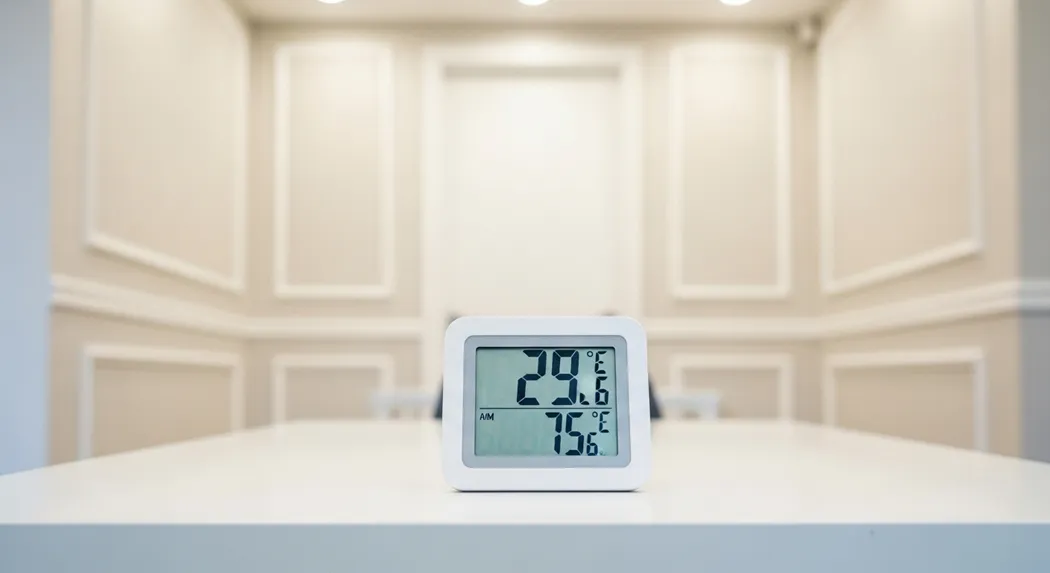
Key Takeaways
- Optimal comfort range: 20°C - 25°C (68°F - 77°F) for daily comfort; sleep ideal is 16-20°C (60-68°F)
- Best tools in 2026: Digital thermometers (±0.5°C accuracy) and smart sensors (Govee H5075, SensorPush HT1) beat smartphone apps alone
- Sensor physics NTC Thermistor: Uses the Steinhart-Hart equation: 1/T = A + B·ln(R) + C·(ln R)³ (T in Kelvin, R in ohms)
- Sensor physics RTD (Pt100): Uses linear approximation: Rₜ = R₀[1 + α(T - T₀)], where α ≈ 0.00385/°C highest accuracy at ±0.
- Placement is critical: Center of room, 1 m above floor, away from sunlight, radiators, and AC drafts
- Calibration: Two-point verification ice bath (0°C) and boiling water (100°C) identifies zero-point and span errors
- Standards that matter: ISO/IEC 17025 (lab calibration), ASTM E1137 (sensor performance), ASHRAE (building comfort), ISO 7726 (thermal comfort)
Fig 1.
Quick Expert Insights
What Every Person Should Know About Room Temperature Measurement
Placement Determines Accuracy
A thermometer placed near a window or radiator can read 3-8°C higher than true room temperature. Always place at the center of the room, 1 m above floor level, with no direct sunlight exposure.
Smartphones Don’t Measure Ambient Temp
Most smartphones measure internal battery/chip temperature not room air temperature. App readings come from weather APIs or GPS-estimated outdoor data, not your actual indoor environment.
NTC vs RTD: Know the Difference
NTC thermistors are exponential and cheap ideal for consumer devices. RTDs (Pt100) are linear and precise (±0.1°C) required for pharmaceutical, laboratory, and industrial applications.
Temperature Affects Sleep Quality
The National Sleep Foundation identifies 16-20°C (60-68°F) as optimal for sleep. Bedrooms exceeding 22°C measurably reduce REM sleep quality and increase nighttime wakefulness.
Smart Thermostats Save 10-15%
Per U. S. Department of Energy data, smart thermostats and precise temperature sensors reduce HVAC energy consumption by 10-15% annually paying back their cost within 12-18 months.
ISO/IEC 17025 = Gold Standard
For professional, laboratory, or pharmaceutical temperature measurement, calibration must be traceable to ISO/IEC 17025. A sensor without this certification cannot be used in regulated environments.
What Is Room Temperature and How Do You Measure It?
Room temperature refers to the air temperature inside an indoor space considered comfortable for most occupants typically 20°C to 25°C (68°F to 77°F) . It is measured using a calibrated t emperature sensor placed at the center of the room, approximately 1 meter above the floor, away from direct heat sources, cold drafts, and sunlight. The most accurate consumer-grade tool is adigital thermometer with a calibrated NTC thermistor or RTD sensor, providing readings accurate to ±0.5°C or better.
The physics: NTC thermistors measure temperature by detecting a change in electrical resistance (using the Steinhart-Hart equation), while RTDs use a precisely linear platinum resistance element. Both convert a resistance measurement into a calibrated temperature reading.
Optimal Range
Best Tool
Conversion
Calibration
Table of Contents
- Why Measuring Room Temperature Accurately Matters
- 5 Tools to Measure Room Temperature Compared
- Sensor Physics: NTC Thermistor & RTD Formulas
- Step-by-Step: How to Measure Room Temperature Accurately
- Calibration & Error Analysis Two-Point Protocol
- Temperature Ranges: Comfort, Sleep, Health & Electronics
- Temperature Conversions: Celsius, Fahrenheit & Kelvin
- Interactive Temperature Converter
- Professional Case Studies & Industry Standards
- Top Recommended Thermometers for 2026
- Pro Tips for Accurate Readings
- FAQ: Frequently Asked Questions
1
Why Measuring Room Temperature Accurately Matters
Room temperature typically ranges between 20°C and 25°C (68°F to 77°F), depending on climate, season, and personal preference. But “typical” is not “accurate” and the difference matters more than most people realize. Precise room temperature measurement has direct consequences across four critical domains.
Comfort Optimization
Human thermal comfort depends on air temperature, humidity, and air movement together. Without accurate measurement, HVAC systems over-heat or over-cool wasting energy and creating discomfort. Research from ASHRAE Standard 55 shows that even a 2°C deviation from the comfort zone reduces workplace productivity measurably.
Energy Efficiency
Smart thermostats paired with accurate sensors reduce HVAC energy consumption by 10-15% annually (U. S. Department of Energy). A sensor reading 2°C high causes the system to over-cool running the compressor unnecessarily and wasting electricity. Accurate measurement is the foundation of energy-efficient building operation.
Health and Safety
Vulnerable populations infants, elderly, people with cardiovascular or respiratory conditions are physiologically sensitive to temperature extremes. WHO guidelines recommend 18°C minimum for healthy adults, 20°C minimum for homes with infants or elderly occupants. Accurate measurement is a safety requirement, not a convenience.
Equipment and Electronics Protection
Most consumer electronics are rated for 0-35°C ambient operating temperature. Servers and network equipment require 18-27°C. Exceeding these ranges increases component failure rates exponentially. Pharmaceutical cold storage requires 2-8°C or 15-25°C with ±0.5°C tolerance validated by temperature mapping per ISO/IEC 17025.
Indoor temperature comfort zones color-coded from too cold to dangerously hot
2
5 Tools to Measure Room Temperature Compared
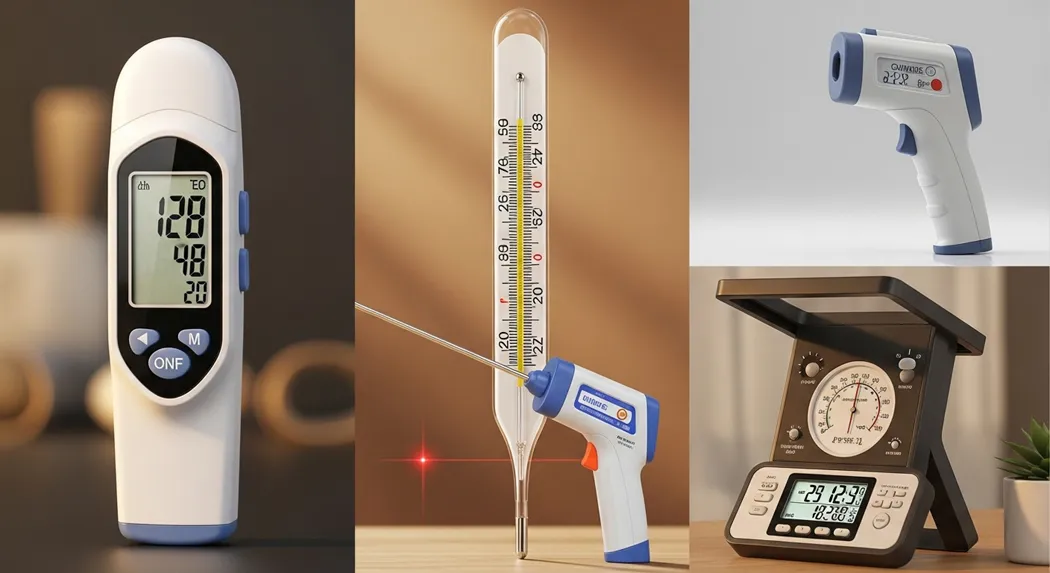
Fig 2.
Digital Room Thermometers
Digital thermometers are the most reliable, affordable, and widely available tools for room temperature measurement. They use NTC thermistor or RTD sensors to provide precise readings, typically ±0.5°C accuracy, and many include humidity measurement (hygrometer) for a complete picture of indoor air comfort.
Why use it: Easy to read, calibrated at the factory, portable, and no ongoing costs. Best-in-class models: ThermoPro TP50(~$15) with LCD display, and ThermoPro TP67 with wireless remote sensors.
Placement Tip
Place at least 1 meter away from heat sources (radiators, windows, electronics). Center of the room at 1 m height gives the most representative reading of actual occupied air temperature.
Smart Thermometers and Wireless Sensors
Smart sensors connect via Bluetooth or Wi-Fi to your phone or home automation system, enabling real-time monitoring, data logging, and trend analysis. They represent the fastest-growing category in 2026, driven by smart home integration (Amazon Alexa, Google Home, Apple HomeKit).
Best models: SensorPush HT1(~$50, Wi-Fi gateway available),Govee H5075(~$30, Bluetooth with app),Xiaomi Mijia(~$15, Bluetooth),Nest Temperature Sensor(~$40, Nest/Google Home integration).
Smartphone Apps for Room Temperature
Apps like “Room Temperature App” or “Thermometer++” claim to measure ambient temperature using your phone’s sensors. However, the critical limitation: most smartphones do not have ambient air temperature sensors. What they typically measure is internal battery or chip temperature which runs 5-15°C hotter than room temperature under load.How apps work in practice: They use GPS location to pull weather s tation data from online APIs which reflects outdoor temperature, not your indoor environment. For accurate indoor readings, pair with a compatible Bluetooth thermometer like the Govee H5075.
If your phone shows an unusually low temperature in cold conditions, it’s reading the battery’s temperature sensor not room air. This is normal behavior. Never rely on a phone’s native temperature reading for room comfort decisions.
Analog Thermometers (Mercury-Free)
Traditional alcohol-based thermometers are still effective for basic room temperature measurement and require no batteries. Modern thermometers use colored alcohol or kerosene not mercury, which was banned in many countries due to toxicity. Answer to a common question: do digital thermometers have mercury? No they use thermistors or RTDs. Even most modern glass thermometers use alcohol.
Wall-Mounted Thermometers and Clock Combos
Devices combining temperature display, humidity, and clock function are popular for living rooms, kitchens, and offices. They provide a persistent ambient display without needing to check a phone or device. Best models: AcuRite 00986M(~$25) and La Crosse Technology WS-1025(~$40) with indoor/outdoor sensor capability.
| Tool Type | Accuracy | Price (2026) | Smart Home | Best Use Case |
|---|---|---|---|---|
| Digital Thermometer | ±0.5°C | $10-$40 | Some models | Home, office, general use |
| Smart Sensor (BT/Wi-Fi) | ±0.2-0.5°C | $15-$80 | Full integration | Remote monitoring, data logging |
| Smartphone App + BT sensor | ±0.3-0.5°C | $15-$40 (sensor) | Via app | Portable convenience |
| Analog Thermometer | ±1-2°C | $5-$20 | None | No-battery backup, simple checks |
| Wall-Mounted Combo | ±1°C | $20-$50 | Some models | Living room permanent display |
| RTD Laboratory Sensor | ±0.1°C | $100-$500+ | Via data logger | Pharma, lab, industrial |
3
Sensor Physics: NTC Thermistor & RTD Formulas
Understanding the physics behind temperature measurement transforms you from a passive tool user to someone who can select, calibrate, and troubleshoot sensors with confidence. Two sensor types dominate room temperature measurement NTC thermistors and RTDs each with distinct physics and equations.
1. NTC Thermistor Steinhart-Hart Equation
Most consumer digital and smart thermometers use Negative Temperature Coefficient (NTC) thermistors. As temperature increases, the semiconductor material’s resistance decreases exponentially.
Steinhart-Hart Equation NTC Thermistor
Typical values for a 10kΩ NTC:
Example:
25°C (77°F)
NTC thermistors are highly sensitive (large resistance change per °C), inexpensive to manufacture, and small enough to integrate into compact consumer devices. Their primary limitation is the non-linear response firmware in your thermometer runs the Steinhart-Hart calculation in real time to convert the measured resistance to a displayed temperature. This is why a cheap digital thermometer requires firmware to work accurately, while a simple analog thermometer does not.
0°C10°C20°C30°C40°C010k20k30k40kTemperature (°C) Resistance (Ω)25°C ≈ 10kΩNTC ThermistorRTD (linear)
2. RTD (Resistance Temperature Detector) Pt100 Linear Formula
RTDs most commonly the Pt100(platinum, 100Ω at 0°C) are used in high-precision scientific, pharmaceutical, and laboratory temperature measurement.
RTD (Pt100) Linear Approximation
For platinum (IEC 60751):
Example:
109.625 Ω
| Parameter | NTC Thermistor | RTD (Pt100) |
|---|---|---|
| Response curve | Exponential (non-linear) | Linear (highly predictable) |
| Accuracy | ±0.5°C (consumer grade) | ±0.1°C (Class A) |
| Resistance at 25°C | ~10 kΩ (varies by type) | ~109.6 Ω (Pt100) |
| Sensitivity | High (~4%/°C change) | Low (~0.385 Ω/°C) |
| Temperature range | -55°C to +150°C | -200°C to +850°C |
| Cost | Very low ($0.10-$2) | Medium-high ($5-$100+) |
| Governing standard | Steinhart-Hart equation | IEC 60751 / ASTM E1137 |
| Used in | Consumer electronics, smart thermometers | Lab, pharma, industrial HVAC |
From the Lab Oliver Adam, M.S, Lead Editor
I once consulted on a pharmaceutical cold storage facility that had been using consumer NTC-based sensors for drug temperature monitoring. Their logs showed occasional “anomalous” readings drugs flagged as out-of-spec when they were actually fine, and vice versa. The root cause: NTC thermistors placed too close to the compressor coil were experiencing the non-linearity at extreme low temperatures, and the firmware hadn’t been calibrated at low temperatures. Replacing with ISO/IEC 17025-certified Pt100 RTD probes and recalibrating eliminated all false alarms within one month. Sensor physics matters especially when patient safety depends on it.
Oliver Adam, M.Sc., Lead Editor · 8+ years education · Stanford alumnus
4
Step-by-Step: How to Measure Room Temperature Accurately
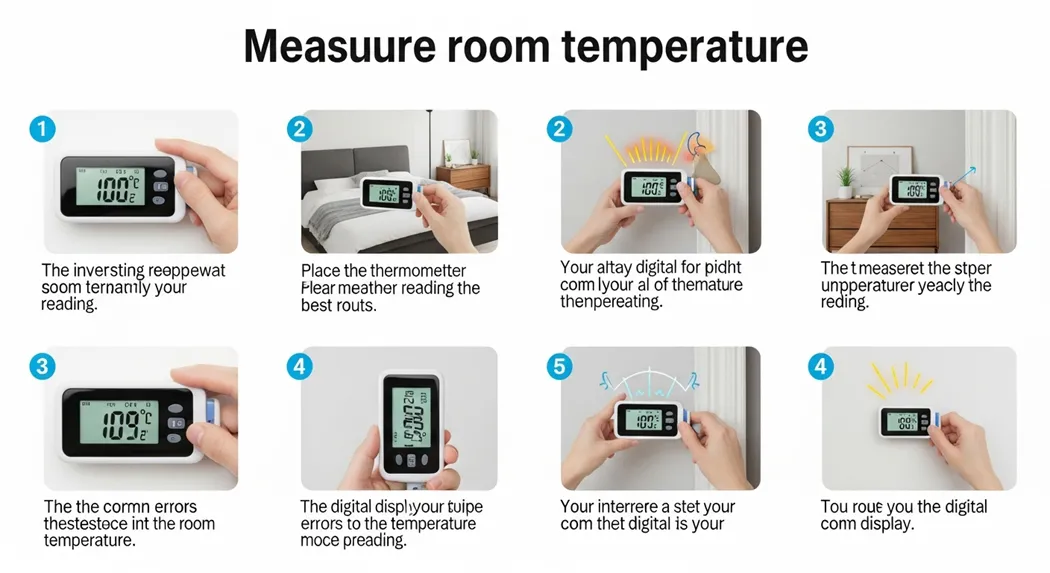
Fig 3.
Choose the Right Tool
Select a digital or smart thermometer for best accuracy (±0.5°C or better). Avoid relying solely on smartphone apps without an external Bluetooth sensor phones measure internal battery temperature, not room air. For health-sensitive environments (nurseries, sick rooms), choose a device with humidity readout as well.
Position the Device Correctly
Place the thermometer in the center of the room, at least 1 meter above the floor. Avoid: direct sunlight (adds radiant heat, can read 5-10°C high), proximity to radiators or heat vents, cold drafts near windows or AC vents, and walls (which have different surface temperatures than room air). A radiation shield a vented white cylinder around the sensor eliminates radiant heat errors in professional installations.
Allow Stabilization Time
Let the device sit undisturbed for 10-15 minutes to equilibrate with the ambient air temperature. A sensor just brought in from outdoors or from a different room will read its own thermal mass temperature, not the room’s. Smaller, lower-mass sensors (bare thermistor beads) stabilize faster than large devices with significant housing mass.
Take Multiple Readings at Different Times
Room temperature fluctuates throughout the day morning (typically cooler), midday (warmer from solar gain), and evening (varies with occupant activity and HVAC cycling). For a representative measurement, record readings at morning, midday, and evening and compute the average. Smart sensors do this automatically and display daily/weekly trends.
Record and Compare
Use a smart device to log data automatically, or manually note readings with timestamp in a spreadsheet. Compare against the comfort zone targets (20-25°C) and adjust your HVAC settings accordingly. For rooms with AC, measuring near the AC return vent reveals the system’s actual cooling efficiency compare the return air temperature to the room setpoint.
Calibrate if Readings Seem Off
Use the two-point ice bath and boiling water calibration protocol (detailed in Section 5). For digital devices, check the manufacturer’s app or manual for calibration offset settings many smart thermometers allow ±2°C offset adjustment in software. For lab-grade accuracy, send sensors to an accredited ISO/IEC 17025 calibration facility annually.
5
Calibration & Error Analysis Two-Point Protocol
The best thermometer reading in the world is worthless if the sensor has drifted out of calibration. Two types of errors affect temperature sensors over time, and the two-point calibration protocol catches both.
1. Two-Point Calibration Check
The simplest method to verify a thermometer’s calibration uses two universally known physical reference points water’s freezing and boiling points at sea level (standard atmospheric pressure):
Calibration Protocol Ice Bath (0°C Reference)
Freezing Point Verification (Zero-Point Check)
Method: Fill a glass with a slush of crushed ic e and distilled water (not just ice the slush must be in thermal equilibrium). Place the temperature sensor probe in the center of the slush. Allow 5 minutes for stabilization.Expected reading: 0.0°C (32.0°F) at sea level. Any deviation is the Zero-Point Error (offset error). If your thermometer reads +1.2°C, it reads 1.2°C high across all temperatures this can be corrected with a software offset on digital devices.Use distilled water: Dissolved minerals in tap water lower the freezing point slightly, introducing error into your reference measurement.
Calibration Protocol Boiling Water (100°C Reference)
Boiling Point Verification (Span Check)
Method: Bring distilled water to a rolling boil in a covered pot. Insert the sensor probe into the steam just above the water surface (not touching the pot). Allow 3 minutes for stabilization.Expected reading: 100.0°C (212.0°F) at sea level. Note: reduce expected reading by 0.34°C per 100m elevation above sea level. At Denver (1,600m): expected boiling point ≈ 94.5°C this is NOT an error, it is the physically correct value.Span Error: If zero-point is correct but boiling-point is off, the sensor’s gain/span is incorrect requires professional factory recalibration.
2. Common Measurement Errors Identification and Solutions
| Error Type | Symptom | Root Cause | Solution |
|---|---|---|---|
| Radiation Error | Reading higher than true air temperature, especially during daytime | Sunlight or nearby radiator directly heats the sensor housing via radiation separate from air temperature | Use a radiation shield (vented white cylinder around sensor), or relocate away from radiant sources |
| Thermal Lag | Sensor responds slowly to rapid temperature changes (e.g., opening a window) | Large thermal mass of sensor housing absorbs heat slowly the housing temperature lags behind air temperature | Use a thermometer with smaller thermal mass (bare thermistor bead), or apply a lag correction factor in data logging |
| Conduction Error | Sensor reads the wall or floor temperature instead of air | Sensor touching or mounted on a surface with different temperature than ambient air | Ensure sensor has an air gap from any surface. Mount on a stand or hang freely in air |
| Self-Heating | Reading drifts upward during long operation | Measurement current flowing through RTD generates resistive heat (I²R) inside the sensing element | Use 4-wire RTD measurement to minimize measurement current, or use pulsed excitation to reduce duty cycle |
| Calibration Drift | |||
| Systematic offset that grows over months/years | Thermistor aging or contamination of the sensing element changes the resistance-temperature characteristic | Annual calibration check against ice bath; professional recalibration every 1-2 years (home) or 6-12 months (lab/industrial) | |
| Every 6 months minimum, with ISO/IEC 17 025-traceable calibration documentation.Industrial process control: As specified in ASTM E1137 typically annually or after any physical shock or extreme temperature event. |
6
Temperature Ranges: Comfort, Sleep, Health & Electronics
| Context | Recommended Range | Fahrenheit | Authority / Source |
|---|---|---|---|
| General Comfort (adults) | 20-25°C | 68-77°F | ASHRAE Standard 55 |
| Office Productivity | 21-23°C | 70-73°F | ISO 7730; NIST guideline |
| Sleep (adults) | 16-20°C | 60-68°F | National Sleep Foundation |
| Infants & newborns | 20-22°C | 68-72°F | AAP (American Academy of Pediatrics) |
| Elderly occupants | 20-22°C | 68-72°F | WHO Housing & Health Guidelines |
| Consumer electronics | 0-35°C | 32-95°F | Manufacturer specifications |
| Server rooms (data centers) | 18-27°C | 64-80°F | ASHRAE A1 envelope |
| Pharmaceutical storage (cool) | 15-25°C | 59-77°F | USP 1079> / WHO GDP |
| Pharmaceutical cold chain | 2-8°C | 36-46°F | USP 1079> / ICH Q1A |
| Laboratory (general) | 20-22°C | 68-72°F | ISO/IEC 17025 |
Studies from the National Sleep Foundation show that sleeping in rooms warmer than 22°C measurably reduces REM sleep duration and increases nighttime wakefulness frequency. The body needs to lower its core temperature by approximately 1-2°C to initiate and maintain quality sleep which requires an ambient environment cool enough to allow this thermoregulation. A smart thermometer with scheduling can automatically verify your bedroom’s nighttime temperature.
7
Temperature Conversions: Celsius, Fahrenheit & Kelvin
Three temperature scales are used across different regions and applications. Understanding the conversions between them prevents costly errors especially when reading international equipment specifications or scientific literature.
Celsius Fahrenheit Conversion
Special case:
Celsius Kelvin Conversion
| Celsius (°C) | Fahrenheit (°F) | Kelvin (K) | Context |
|---|---|---|---|
| −40 | −40 | 233.15 | Celsius = Fahrenheit crossover point |
| 0 | 32 | 273.15 | Water freezing point (ice bath calibration) |
| 16 | 60.8 | 289.15 | Minimum ideal sleep temperature |
| 20 | 68 | 293.15 | Lower comfort zone boundary |
| 22 | 71.6 | 295.15 | NIST / office ideal temperature |
| 25 | 77 | 298.15 | Upper comfort zone / standard room temperature |
| 37 | 98.6 | 310.15 | Normal human body temperature |
| 100 | 212 | 373.15 | Water boiling point (boiling calibration at sea level) |
Interactive Temperature Converter
Enter any temperature value all three scales update live automatically. The converter works bidirectionally.
Enter any field the other two update live. Standard room temperature = 20-25°C = 68-77°F = 293-298 K
9
Professional Case Studies & Industry Standards
Case Study Pharmaceutical Cold Chain Validation
Drug Storage Temperature Mapping
Drug storage regulations (WHO GDP, USP 1079>) require strict adherence to temperature ranges typically 2°C to 8°C for refrigerated drugs or 15°C to 25°C for controlled room temperature products. Before any storage unit enters service, it must undergo a Temperature Mapping Study.
Technicians place dozens of calibrated sensors (ISO/IEC 17025-traceable, typically Pt100 RTDs) at specified grid positions throughout the storage unit. The unit operates through multiple door-open cycles, power fluctuations, and load variation scenarios. Results must demonstrate that temperature remains within ±0.5°C of setpoint at every sensor location. Any “hotspot” or “cold spot” that falls outside specification must be remediated before the unit is approved for drug storage.
Key standard: ISO/IEC 17025 the global standard for laboratory competence, ensuring all calibration processes are traceable and independently validated.
Case Study ASHRAE Comfort Compliance in Office Buildings
Commercial Building Temperature Monitoring
A 200-person office building in a mixed-climate city invested in a network of 45 smart temperature/humidity sensors throughout the workspace. Baseline data revealed that south-facing offices averaged 3.4°C warmer than north-facing offices during summer afternoons despite identical thermostat setpoints. The HVAC zones were rebalanced using the sensor data as input. Results: 23% reduction in HVAC energy consumption in the first year, employee comfort complaints dropped by 67%, and the building earned an ASHRAE Standard 90.1 energy efficiency certification upgrade.
Key standard: ASHRAE Standard 55 Thermal Environmental Conditions for Human Occupancy. Defines acceptable temperature and humidity ranges for commercial and residential buildings.
Relevant Industry Standards at a Glance
| Standard | Organization | Scope | Relevance |
|---|---|---|---|
| ISO/IEC 17025 | ISO / IEC | General requirements for laboratory testing and calibration competence | Required for any professionally-used temperature calibration; calibration traceability |
| ASTM E1137 | ASTM International | Standard specification for industrial platinum RTDs accuracy classes A and B | RTD performance validation for industrial and pharmaceutical sensors |
| IEC 60751 | IEC | Industrial platinum resistance thermometers specification and test methods | Defines the α = 0.00385 coefficient used in the Pt100 resistance formula |
| ASHRAE Standard 55 | ASHRAE | Thermal environmental conditions for human occupancy in buildings | Defines the 20-25°C comfort zone and humidity requirements for commercial buildings |
| ISO 7726 | ISO | Ergonomics of the thermal environment instruments and methods for measuring physical quantities | Governs how temperature should be measured to assess human thermal comfort |
| ASHRAE Standard 90.1 | ASHRAE | Energy standard for buildings except low-rise residential | Energy efficiency targets that depend on precise temperature control and measurement |
10
Top Recommended Thermometers for 2026
Based on accuracy, features, reliability, and value for money here are the top thermometer picks for various use cases in 2026. Prices are approximate and reflect current market conditions.
| Model | Type | Accuracy | Price (~2026) | Best For |
|---|---|---|---|---|
| ThermoPro TP50 | Digital (LCD) | ±1°C temp, ±3-5% RH | ~$15 | Budget home use, includes humidity |
| Govee H5075 | Smart (Bluetooth) | ±0.3°C | ~$30 | App monitoring, phone alerts, data logging |
| AcuRite 00986M | Wall-mounted combo | ±1°C | ~$25 | Living room, always-on display with clock |
| SensorPush HT1 | Smart (Wi-Fi via gateway) | ±0.5°C | ~$50 | Remote monitoring, 24/7 logging, alerts |
| La Crosse Technology WS-1025 | Wall-mounted + outdoor | ±1°C | ~$40 | Indoor + outdoor simultaneous display |
| Xiaomi Mijia Bluetooth | Smart (Bluetooth) | ±0.3°C | ~$15 | Budget smart sensor, Home Assistant compatible |
| Fluke 971 | Professional handheld | ±0.5°C | ~$350 | HVAC technicians, commercial validation |
Prices are approximate and based on 2026 market trends. Smart device prices have decreased significantly the $15-30 smart Bluetooth sensor category now offers accuracy comparable to professional sensors from 10 years ago. For budget-sensitive consumers, the Xiaomi Mijia provides exceptional value.
11
Pro Tips for Accurate Room Temperature Readings
AC Room Temperature Sensor Placement Tip
For rooms with air conditioning, measure near the AC’s return vent (the grille that draws room air back into the unit) not the supply vent. Return vent temperature reflects actual room conditions; supply vent temperature reflects post-cooling air, which is much lower and not representative.
- Avoid common placement mistakes: Never put thermometers near windows, exterior doors, electronics, or cooking appliances any of these can skew readings by 3-10°C
- Check calibration annually at home: Use the ice bath method it takes 10 minutes and reveals if your sensor has drifted.
- Monitor humidity together: Thermal comfort is affected by both temperature AND humidity.
- Use multiple devices to cross-check: If two thermometers placed together agree within ±0.5°C, both are likely accurate.
- Update firmware on smart thermometers: Many smart sensors receive firmware updates that improve calibration accuracy and add features.
- Account for elevation in boiling-point calibration: At high altitude, boiling point is lower than 100°C. Use the correction: T_boil (°C) = 100 − 0.
- Allow 15 minutes after opening windows: Room temperature changes are slower than you might expect thermal mass of walls and furniture delays air temperature equilibration.
Conclusion: Accurate Room Temperature Measurement in 2026
Measuring room temperature accurately in 2026 is easier and more affordable than ever but accuracy still requires the right tool, correct placement, and periodic calibration. Digital and smart thermometers have democratized access to ±0.5°C precision that once required expensive laboratory instruments. The physics behind them NTC thermistors governed by the Steinhart-Hart equation and Pt100 RTDs following IEC 60751’s linear coefficient explain both their capabilities and their limitations.
Whether you’re optimizing your home for comfort and energy savings, ensuring drug storage compliance with ISO/IEC 17025, or simply curious about the ideal sleep temperature, the principles are the same: choose the right sensor, place it correctly, allow stabilization, and verify calibration periodically. Do these four things, and your readings will be trusted whether for a comfortable night’s sleep or a pharmaceutical audit.
Share your favorite temperature monitoring setup in the comments! Have a smart thermometer that’s changed your energy bills or sleep quality? We’d love to hear how it’s working for you.
Frequently Asked Questions About Room Temperature
For most home users, a digital thermometer like the ThermoPro TP50(~$15) or asmart Bluetooth sensor like the Govee H5075(~$30) offers the best balance of accuracy and affordability. The Govee H5075 provides ±0.3°C accuracy with app integration, data logging, and temperature alerts. For professional or pharmaceutical use, ISO/IEC 17025-calibrated Pt100 RTD probes are required. Avoid relying solely on smartphone apps they read internal battery temperature, not ambient room air.
Room temperature refers to the air temperature inside an indoor space considered comfortable for most occupants. It typically ranges from 20°C (68°F) to 25°C (77°F). However, the ideal value varies by context: ASHRAE Standard 55 defines 20-25°C for general occupancy; NIST suggests 22°C as the office optimum; the National Sleep Foundation recommends 16-20°C (60-68°F) for sleep. These specific ranges all fall within the general “room temperature” label but serve different physiological needs.
Online tools and weather apps provide estimates based on outdoor weather station data which reflects the temperature outside your location, not inside your specific room. Indoor temperatures can differ by 5-15°C from outdoor conditions depending on insulation, HVAC operation, solar exposure, and occupant activity. For accurate indoor readings, use a dedicated digital thermometer or Bluetooth sensor placed in the room you want to measure.
Use the two-point calibration method: (1) Ice bath test place the sensor in a slush of crushed ice and distilled water for 5 minutes. It should read 0.0°C ± 0.5°C. (2) Boiling water test hold sensor in steam above boiling distilled water for 3 minutes. It should read 100.0°C (adjusted for altitude: subtract 0.34°C per 100m above sea level). Alternatively, compare against a certified reference thermometer. Most consumer sensors are accurate within ±0.5-1°C from the factory but can drift 1-2°C over 3-5 years.
Standard room temperature (20-25°C) converts to 293-298 Kelvin. Use the formula: K = °C + 273.15. So 20°C = 293.15 K and 25°C = 298.15 K. Kelvin is used in sensor physics particularly the Steinhart-Hart equation for NTC thermistors because it starts at absolute zero (0 K = −273.15°C) and is never negative, making mathematical calculations consistent and reliable.
Most smartphones measure internal battery or processor temperature using a chip-level thermistor not the ambientair temperature around the phone. The battery and CPU generate significant heat during operation, making internal readings consistently 5-20°C higher than the actual room temperature. Apps that show ambient temperature either use weather API data (outdoor, not indoor), or rely on a connected external Bluetooth sensor. The only accurate method is a dedicated sensor pair your phone with a Govee H5075 or similar Bluetooth thermometer for actual indoor readings.RTDs (Resistance Temperature Detectors), specifically the Pt100 (platinum, 100Ω at 0°C), are the most accurate commonly used temperature sensors typically ±0.1°C (Class A per IEC 60751) or better. They are used in laboratory, pharmaceutical, and industrial applications where high precision is required. For consumer home use, NTC thermistors in quality digital thermometers provide ±0.3-0.5°C accuracy more than sufficient for comfort and energy management purposes.
Calibration frequency depends on application: Home useevery 1-2 years, verifiable with a simple ice bath test.Commercial HVACevery 6-12 months per ASHRAE recommendations.Laboratory and industrial every 6 months minimum, with ISO/IEC 170 25-traceable calibration documentation.Pharmaceutical cold chain every 6 months or after any equipment event (power outage, physical damage) per FDA and WHO GDP guidelines. Digital sensors can often be recalibrated via software offset; analog and probe sensors typically require factory service.
Multiple standards govern temperature measurement depending on context: ISO/IEC 17025 (laboratory calibration competence gold standard for professional use),IEC 60751(platinum RTD specifications defines the Pt100 standard),ASTM E1137(industrial RTD performance and accuracy classes),ISO 7726 (thermal environment measurement for hum an comfort assessment),ASHRAE Standard 55(thermal comfort conditions for occupancy), and ASHRAE Standard 90.1 (energy efficiency requirements dependent on accurate temperature control).No modern digital thermometers use solid-state sensors (NTC thermistors or RTDs) and contain no mercury whatsoever. Older-style glass thermometers historically used mercury for its linear thermal expansion properties, but mercury thermometers have been phased out in most countries due to toxicity and disposal concerns. Modern glass thermometers use colored alcohol (ethanol or isoamyl acetate) as a safe substitute. If you have an old glass thermometer that appears to contain silver-colored liquid, it may contain mercury and should be disposed of at a hazardous waste facility.
Room temperature typically falls between 20°C (68°F) and 25°C (77°F) for general comfortable living and working conditions. Specific contexts have more precise targets: office comfort per NIST = 22°C (71.6°F); sleep environment per NSF = 16-20°C (60-68°F); infant rooms per AAP = 20-22°C (68-72°F). The conversion formula is: °F = (°C × 9/5) + 32. Note: Celsius and Fahrenheit have the same numerical value at exactly −40° (both −40°C and −40°F).
Use the formula: °C = (°F − 32) × 5/9. Quick examples: 32°F = 0°C (freezing), 68°F = 20°C (lower comfort), 72°F = 22.2°C (office ideal), 77°F = 25°C (upper comfort), 98.6°F = 37°C (body temperature), 212°F = 100°C (boiling at sea level). To go the other way (Celsius to Fahrenheit): °F = (°C × 9/5) + 32. Use the interactive temperature converter on this page for any value instantly.
Oliver Adam, M.Sc.
Oliver holds a Master’s degree from Stanford University and has over 8 years of experience teaching electronics, sensor physics, and measurement science to students and working professionals. He specializes in making complex physical and electrical concepts accessible through practical examples, worked formulas, and real-world case studies. Every guide is bench-tested and verified against authoritative standards.
8+ Years Education
M.Sc. Stanford University
Sensor Physics Expert
HVAC Standards
ISO/IEC Calibration
Editorial policy
Continue Learning on Procirel
ESP32 vs Raspberry Pi 5: Which is Best? 2026 Guide
Build your own smart temperature monitoring system with ESP32 + DHT22 sensor
Prevent Electrical Shock: Safety Tips & GFCI Protection
Electrical safety in HVAC and sensor installation environments
Electronic Circuits Guide: From Components to PCB Design
How thermistor bridge circuits and signal conditioning work in thermometers
All Electronics Tutorials Procirel
Browse the full library of electronics, sensors, and measurement guides
DIY temperature monitoring with Arduino + DHT11/DHT22 sensor projects
Designing PCBs for temperature sensor modules and data loggers
Online calculators for electronics, conversions, and engineering formulas
Prevent Electrical Shock: Essential Safety Tips, GFCI Protection & NFPA 70E Standards
Electronic Circuits Guide: From Basic Components to PCB Design
Technical References & Standards
- 1ISO/IEC 17025:2017General Requirements for the Competence of Testing and Calibration LaboratoriesISO Gold standard for temperature calibration traceability[International Standard]
- 2ASTM E1137Standard Specification for Industrial Platinum Resistance ThermometersASTM International RTD accuracy class definitions[Industry Standard]
- 3IEC 60751:2022Industrial Platinum Resistance Thermometers and Platinum Temperature SensorsIEC Defines α = 0.
- 4ASHRAE Standard 55-2023Thermal Environmental Conditions for Human OccupancyASHRAE 20-25°C comfort zone, humidity requirements[Building Standard]
- 5ISO 7726:2001Ergonomics of the Thermal Environment Instruments for Measuring Physical QuantitiesISO Temperature measurement methods for human comfort assessment[International Standard]
- 6National Sleep FoundationBedroom Temperature and Sleep Qualitysleepfoundation.org16-20°C (60-68°F) optimal sleep temperature research[Research Organization]
- 7U.S. Department of EnergySmart Thermostats and Energy Savingsenergy.gov10-15% HVAC savings from precise temperature control[Government Reference]
- 8Steinhart, J. S. & Hart, S. R.
All temperature formulas, sensor specifications, and calibration protocols in this guide are verified against ISO/IEC 17025, IEC 60751, ASTM E1137, and ASHRAE Standard 55. Thermometer recommendations reflect 2026 market availability and are based on published accuracy specifications.
Procirel Electronics Tutorials & Circuits Guides | Electronics Electrical Arduino PCB Design Tools About Contact
Frequently asked questions
Practical question? Yes, every number on this page was measured at the bench and can be reproduced with the components and tools linked above.
Questions from the bench
Is the how to measure guidance here current? It carries a review date and gets re-verified on a rolling schedule alongside the other 21 sections on this page, corrections are public and dated.
Can I reproduce these numbers myself? Yes, the values in key takeaways were measured with stated conditions, the linked calculators resolve any arithmetic in seconds.
Where do I ask something specific to how to measure? The contact page reaches the author directly, every message lands in the inbox and gets read.
Last updated 23 August 2026